
An electrician's website has a harder job than almost any other trade's, and it is not about design. You sell the same skill to a homeowner, a letting agent and a facilities manager, and those three want completely different things from a page. Most electrician sites are written for the homeowner and quietly lose the other two.
01The readers Who is actually on the site.
- The homeowner Extra sockets, a fuse board that keeps tripping, outside lights, a kitchen rewire. Reads the site properly, in the evening, and is mostly deciding whether you seem competent and whether you will turn up. Photographs and reviews do this work.
- The letting agent or landlord Wants an EICR booked across several properties with the least admin possible. Does not care about your gallery at all. Wants your registration, your turnaround, and a way to book without a phone conversation.
- The facilities or site manager Commercial work, and a completely different set of questions: insurance limits, method statements, whether you can work out of hours, and whether you have done a building like theirs before.
- And the person you want to hire Worth naming, because in this trade it matters. Electricians check your site before answering a job advert. A site that looks like a going concern quietly helps you recruit, which few people build for.
You do not need four separate websites. You need the first screen to offer an obvious route for each, and then pages written properly for each route rather than one set of pages hedging between them.
02The forwarding test Your site is a document that gets forwarded.
Here is the thing that separates electrical work from most trades on this site. Somebody is going to send your website to somebody else.
A letting agent forwards it to a landlord for approval. A site manager sends it to procurement. A homeowner sends it to their partner. In every case the page is being read by a person who did not choose to visit it and has no context, and it has to stand up on its own.
That changes what belongs on it. Registration numbers, insurance figures and accreditations become load-bearing, because they are exactly what the second reader is checking. Put your NICEIC or NAPIT number in text where it can be copied and verified, not baked into a badge image.
It also means every page needs to make sense cold. Somebody landing straight on your EICR page from a forwarded link should be able to tell who you are, where you work and how to book, without going to the home page first.
03The inventory The pages an electrical site actually needs.
Ordered by how reliably they bring work, which is not the order most electricians build them in.
EICR and landlord certificates first. It is a legal requirement on a five-year cycle, so the demand does not care what the economy is doing, and it brings people who own more than one property. Almost every electrician has this as a line item on a services page rather than a page of its own.
Then consumer unit and fuse board upgrades, full and partial rewires, fault finding, outdoor and garden lighting, and EV charger installation. If you do commercial, that gets its own section rather than a paragraph.
A rewire page is worth unusual effort. It is the highest-value domestic job you do, the customer is frightened of the disruption rather than the price, and a page that honestly explains what a fortnight of rewiring is actually like will out-convert anything else on the site.
04The pictures What to photograph when the work is inside a wall.
This is a genuine problem for electricians and it is worth solving rather than giving up and buying stock images.
Photograph the result, not the work.
- A kitchen with the under-cabinet lighting on.
- A garden lit at dusk.
- A loft conversion with the sockets where somebody actually wanted them.
Nobody wants to look at cable runs, but everybody wants the room at the end of them.
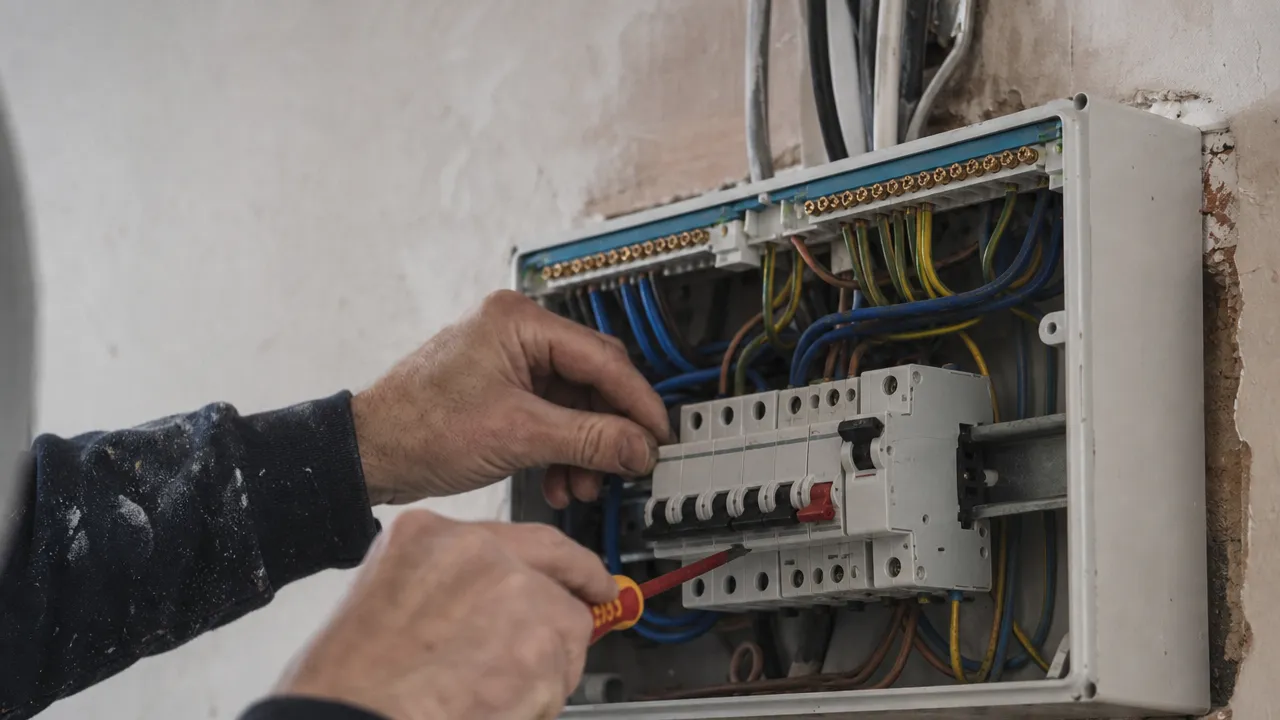
Then photograph yourself. A customer is deciding whether to let a stranger into the house for a fortnight, and a face does more for that than any amount of copy. The van, the board with the cover on and neatly labelled, you in work clothes rather than a suit.
07700 900274
Mobile
Included, and it runs on its own
A missed call still becomes a job.
This is the same system every site here is wired into. The text goes out whether you remember or not.
- It fires in about eight seconds Before they have scrolled to the next name in the results.
- They reply while it is still in their head And it is waiting for you when you come down off the job.
- You do nothing at all Evenings, weekends, and the days you leave your phone in the van.
05The price What it costs.
£297 a month. That is the site plus missed-call text-back, the review funnel, follow-up on every enquiry, one inbox and a business number. The full list is on the pricing page.
No build fee and no minimum term, so there is nothing to commit to beyond the first month.
If the problem is that nobody is finding you rather than what happens when they do, the electrician SEO page is the one to read. It covers the searches, the map pack and the landlord work.
06The awkward ones Common questions about electrician websites.
01 How is this different from the SEO page for electricians?
That page is about getting found, the searches, the map pack, and the landlord work nobody chases. This one is about what the site has to contain and how it should be arranged. If you already rank and enquiries still do not come, the problem is on this page rather than that one.
02 Should my registration number be on every page?
The number rather than the logo, and yes, in the footer at minimum. NICEIC and NAPIT both run public registers, so a number is checkable and a logo is not. It is the fastest way to separate yourself from somebody who has simply downloaded the badge.
03 Do I need a separate section for commercial work?
If you genuinely do it, yes, and it should look different from the domestic side. A facilities manager reading pages written for homeowners assumes you are a domestic sparky having a go, and a homeowner reading commercial pages finds you intimidating and expensive.
04 What should the enquiry form ask?
Property type, roughly when it was built, and what the job is. Those three answers tell you more about whether a rewire quote is worth driving to than any amount of back-and-forth, and asking them filters out the people who wanted a price over the phone.
05 Electrical work is not very photogenic. What do I show?
Almost nobody wants a photograph of a consumer unit, true. Show the finished room rather than the work, a kitchen with the lighting on, a garden lit at dusk, a clean board with the cover on. And show yourself and the van, because the customer is buying a person coming into their house.
06 Is it worth having a page for EV charger installation?
Worth a page, not worth building the site around. Homeowner demand is real and the national installers are bidding hard on it, so it is more competitive than it looks. I would put it after the EICR, fuse board and rewire pages rather than before them.
Send me the address before the call and I'll give you a straight opinion on what you have got now. Twenty minutes, and you'll know whether the site is losing you the landlord and commercial work rather than the domestic. Book a call. Tell me what's going on.